
Other
Firebase Storage
Manage files in Firebase (and Google Cloud) Storage
Firebase Storage (and Google Cloud Storage)
Fuego provides an intuitive and powerful interface to manage your Firebase Cloud Storage buckets and files. This feature goes beyond the Firebase Console by offering advanced tools like bulk downloads, file previews, metadata editing, version history, and multi-bucket navigation—all from a native desktop application.
Buckets Overview
The Storage home starts from where you left off. At the top is the bucket you used last, with Continue (or Enter) to go back to the folder you were in. The path is shown level by level, and Folders here lists the folders of that place: click a level or a folder to open the bucket right there. Next to it are your other open bucket tabs and your Storage bookmarks. Before you open any bucket, the top shows the project’s default bucket.
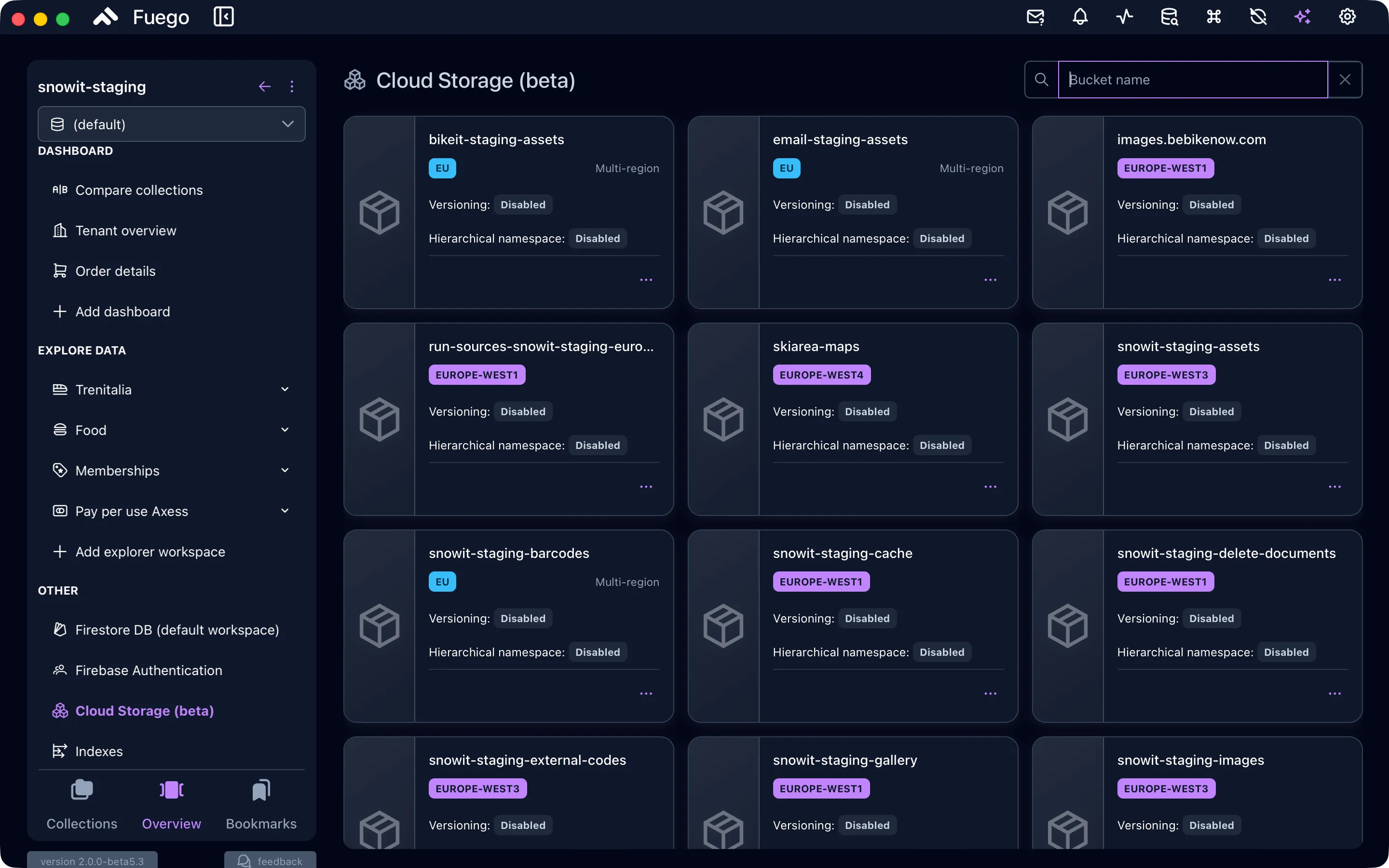
Below, Buckets lists every bucket of the project. Each card shows:
- The bucket’s name, or the display name you gave it (with the bucket’s own name next to it)
- Its location (e.g.
eu,us-central1) - A tag only for what is not the usual: Multi-region or Dual-region, Default, a storage class other than Standard, Versioning or Hierarchical namespace turned on
Type in the filter to find a bucket by name; Enter opens the first match. Drag the cards to reorder them. A card’s menu bookmarks the bucket, changes its display name or hides it; hidden buckets are listed at the bottom.
Exploring Buckets and Files
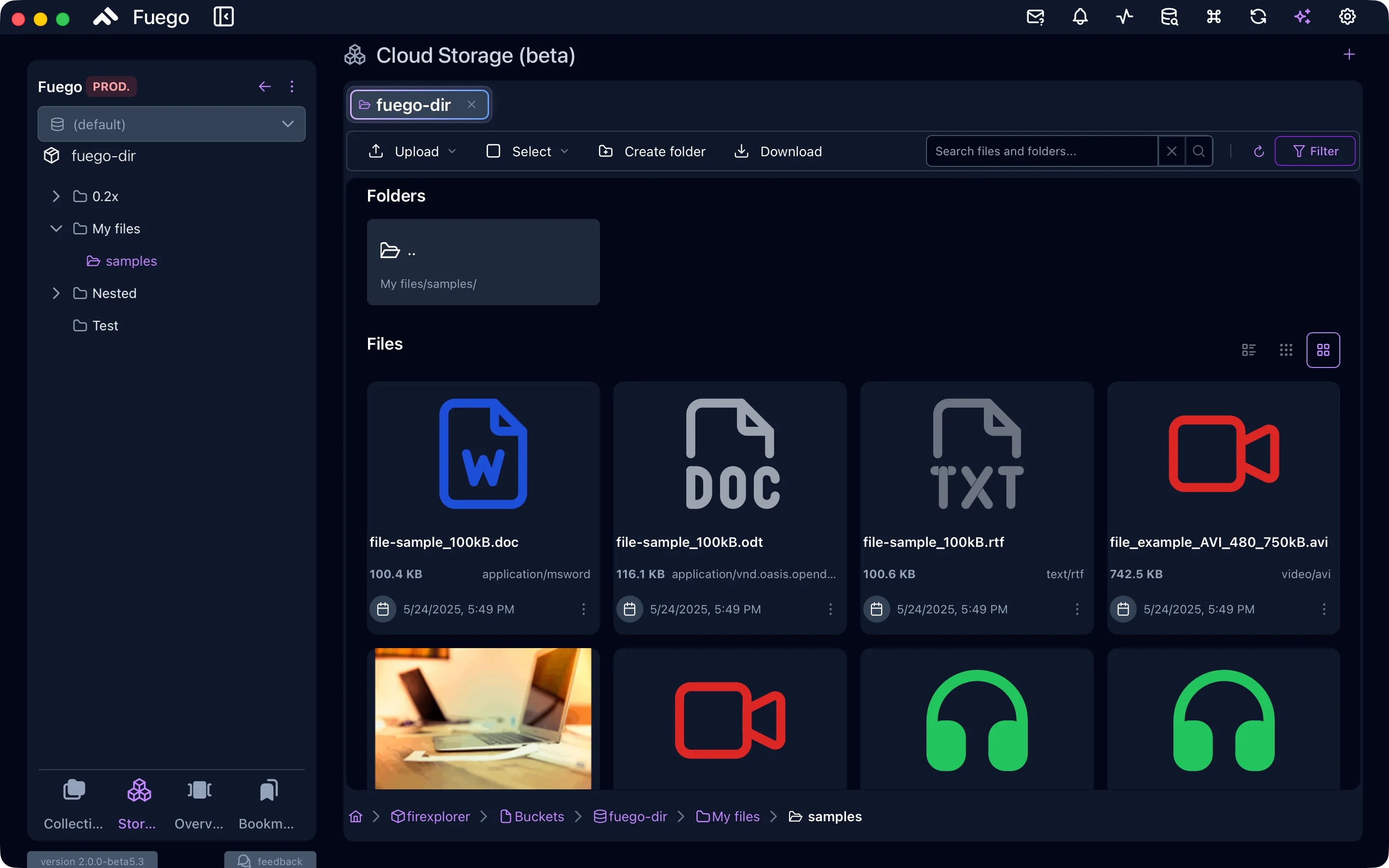
Once a bucket is selected, you’ll be able to browse folders and files using a structured tree view and a responsive file grid. You can:
- Navigate nested directories
- View file details such as size, type, and timestamp
- Switch between list and grid views
Search and Filter
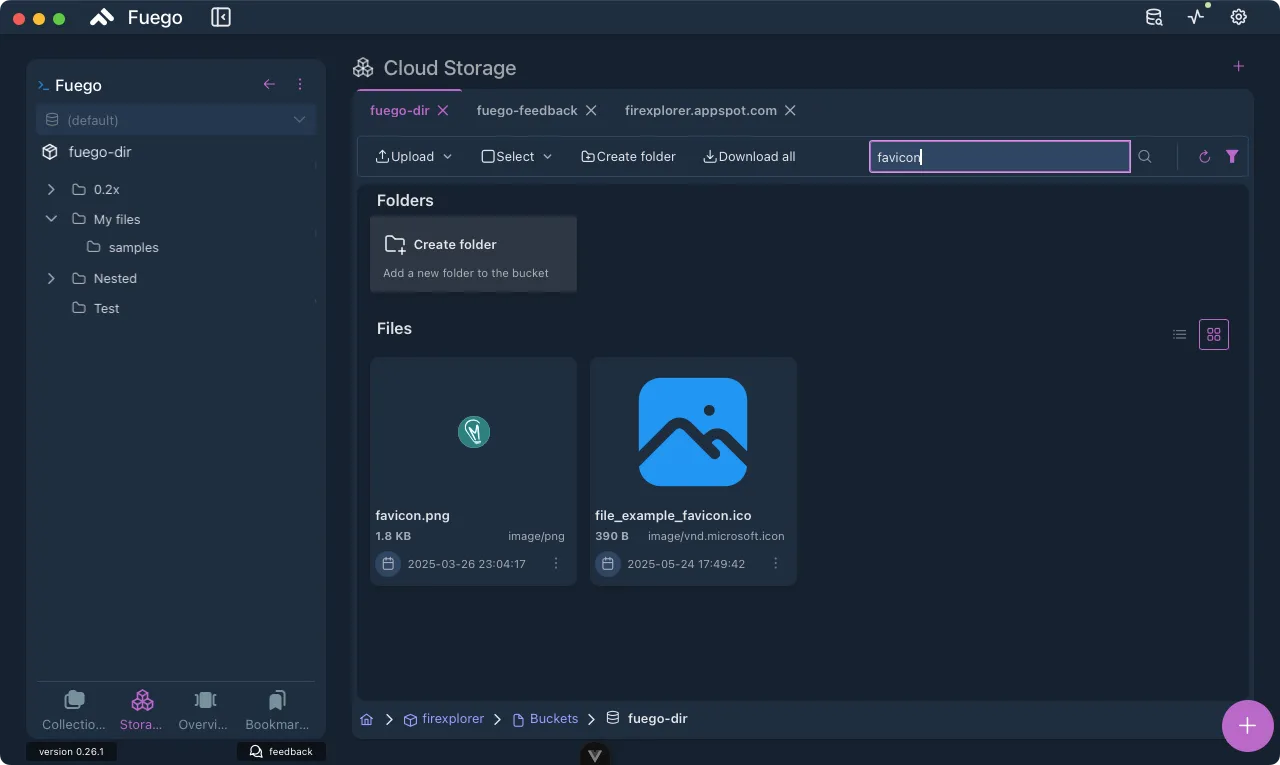
The search box in the toolbar (or ⌘ ⇧ F / Ctrl ⇧ F) opens a popover with two ways to search and every listing option:
- Text (the default): finds files and folders whose name contains the text, in every folder of the bucket
- Glob pattern: a Cloud Storage glob
such as
**/*.pdforimages/*.png(the delimiter must then be/or none) - Listing options: prefix, delimiter, start/end offset, page size and soft-deleted objects
The box summarizes the active search and filters; its × button clears them and brings the previous folder back.
File Previews
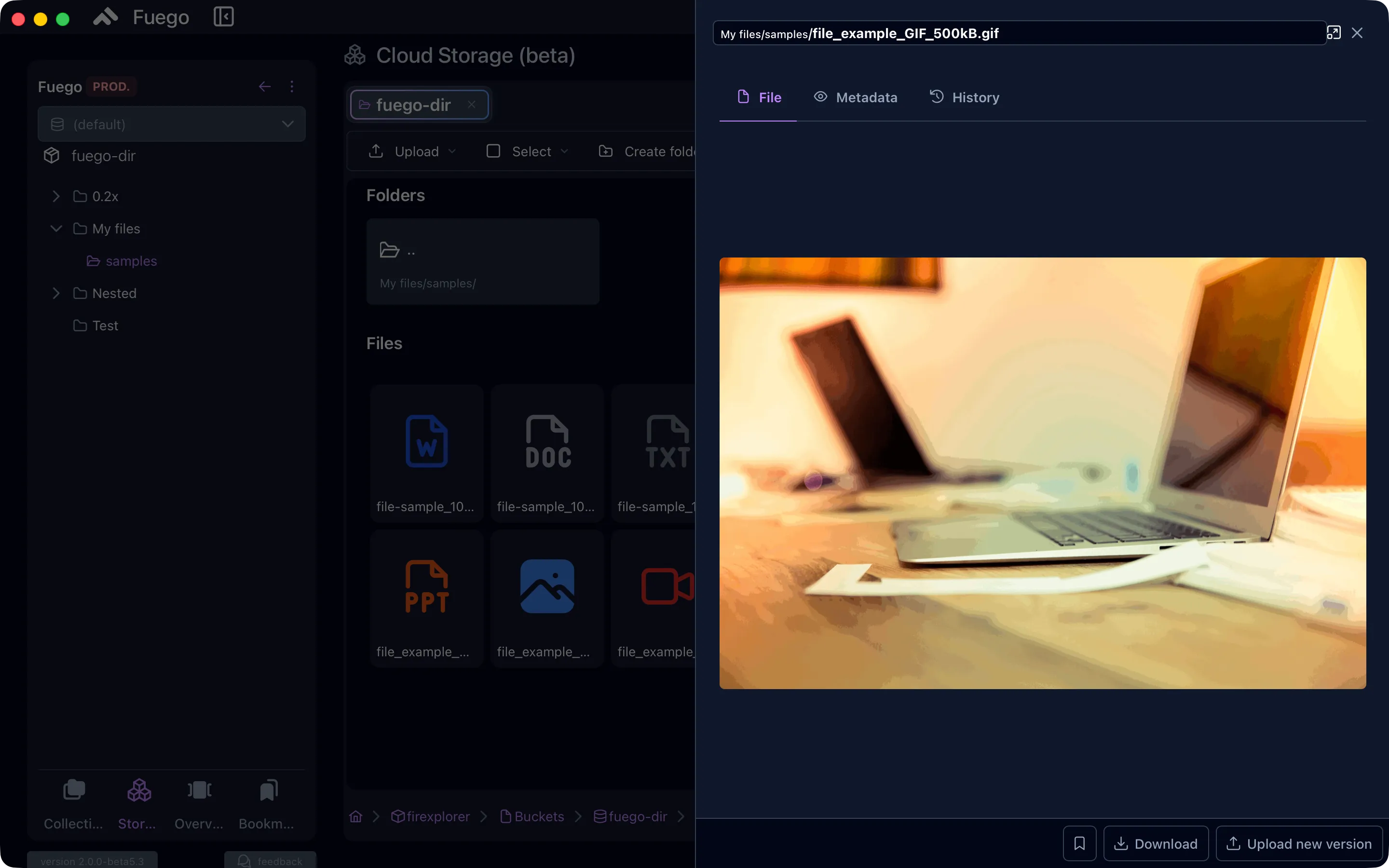
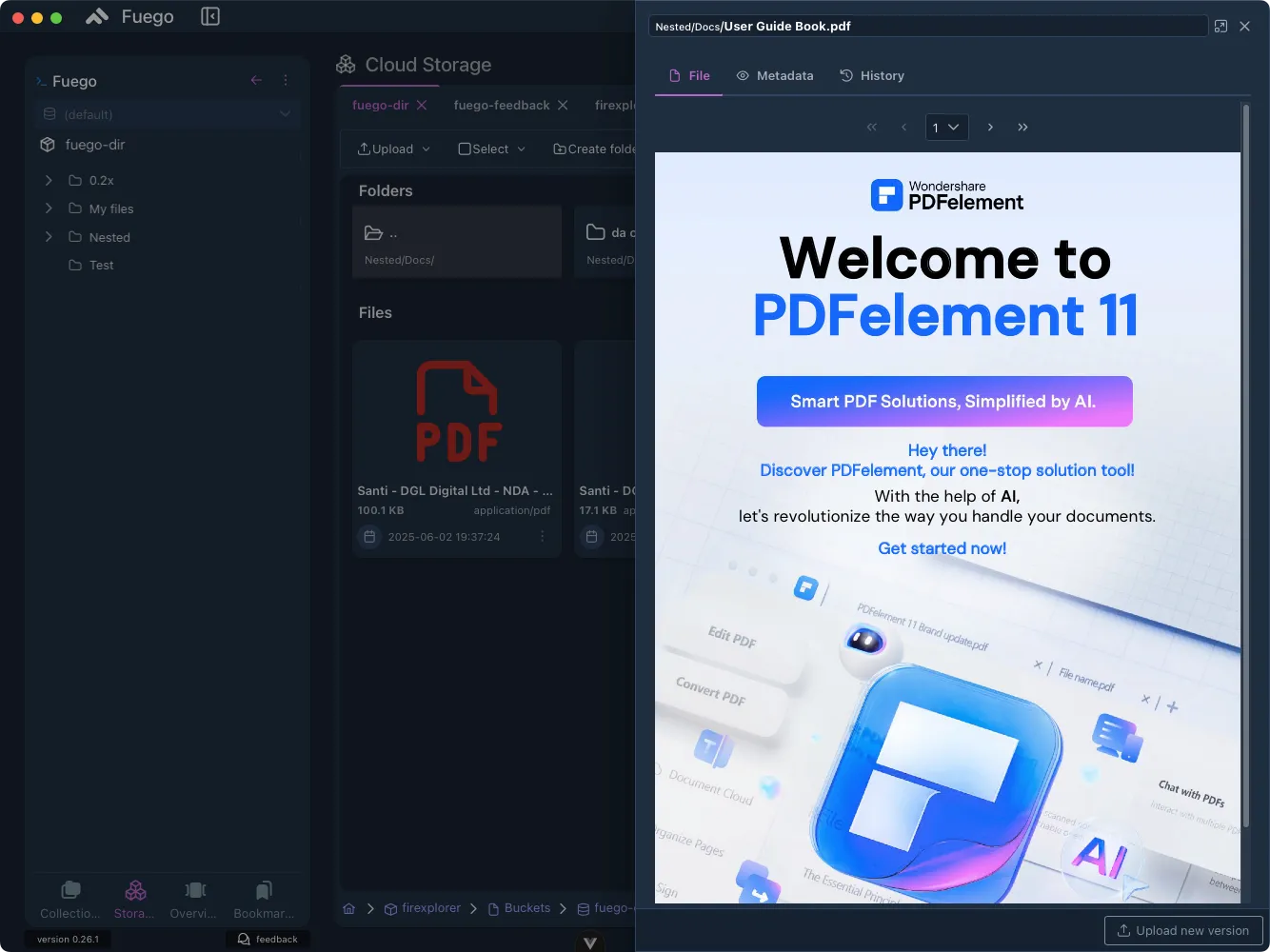
Fuego allows you to preview a wide range of file types directly in the app:
- Images (e.g. PNG, JPEG, GIF)
- Videos (e.g. MP4, MOV, AVI)
- PDFs and text files
File Metadata
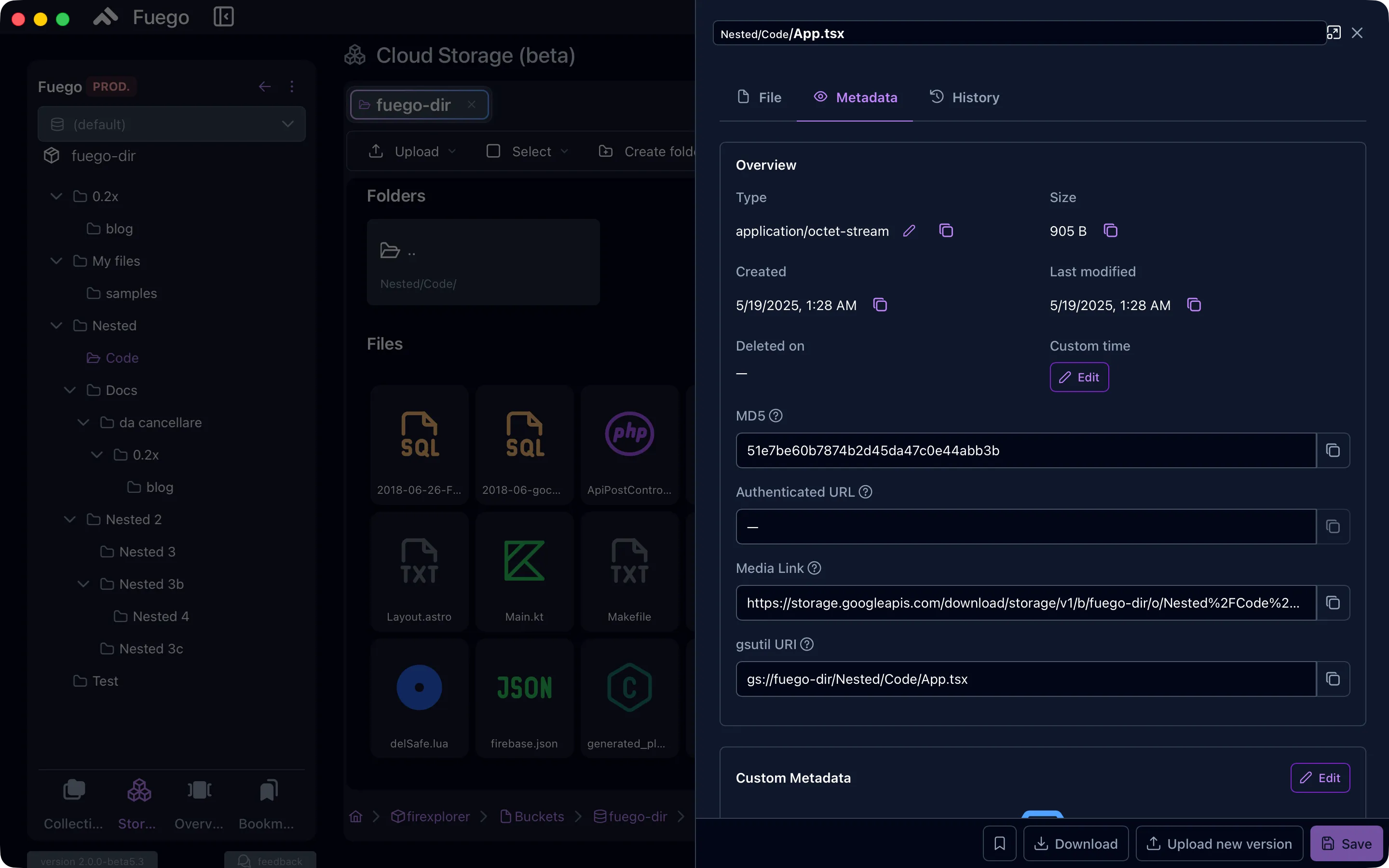
Select any file to view and edit its metadata, including:
- Type, size, timestamps, MD5 hash
- Public download URL and gsutil path
- Custom metadata (e.g. language: golang)
Version History
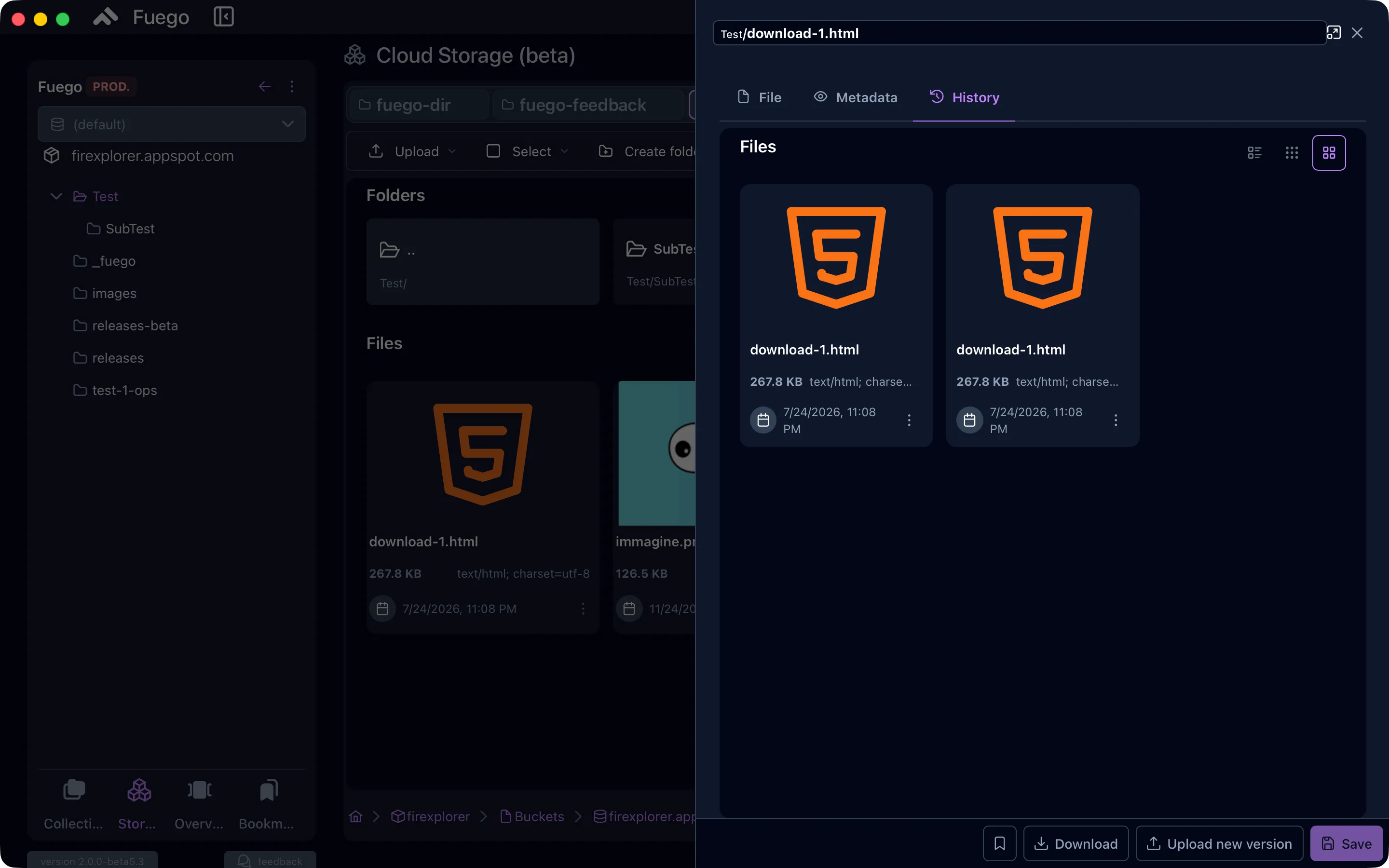
If versioning is enabled for the bucket, you can inspect the history of each file, including past versions and their timestamps. You can also upload a new version of a file without changing its reference path.
Saving an edited file, uploading a new version of it, or uploading a file over one with the same name keeps the file’s metadata, including the token of its Firebase download URLs, so the links to it keep working. If someone changed or deleted the file after you opened it, saving it or uploading a new version writes nothing and tells you why.
The Storage emulator keeps no earlier versions and no soft-deleted files: the History tab and a soft-deleted listing of an emulator project say so.
Supported File Types
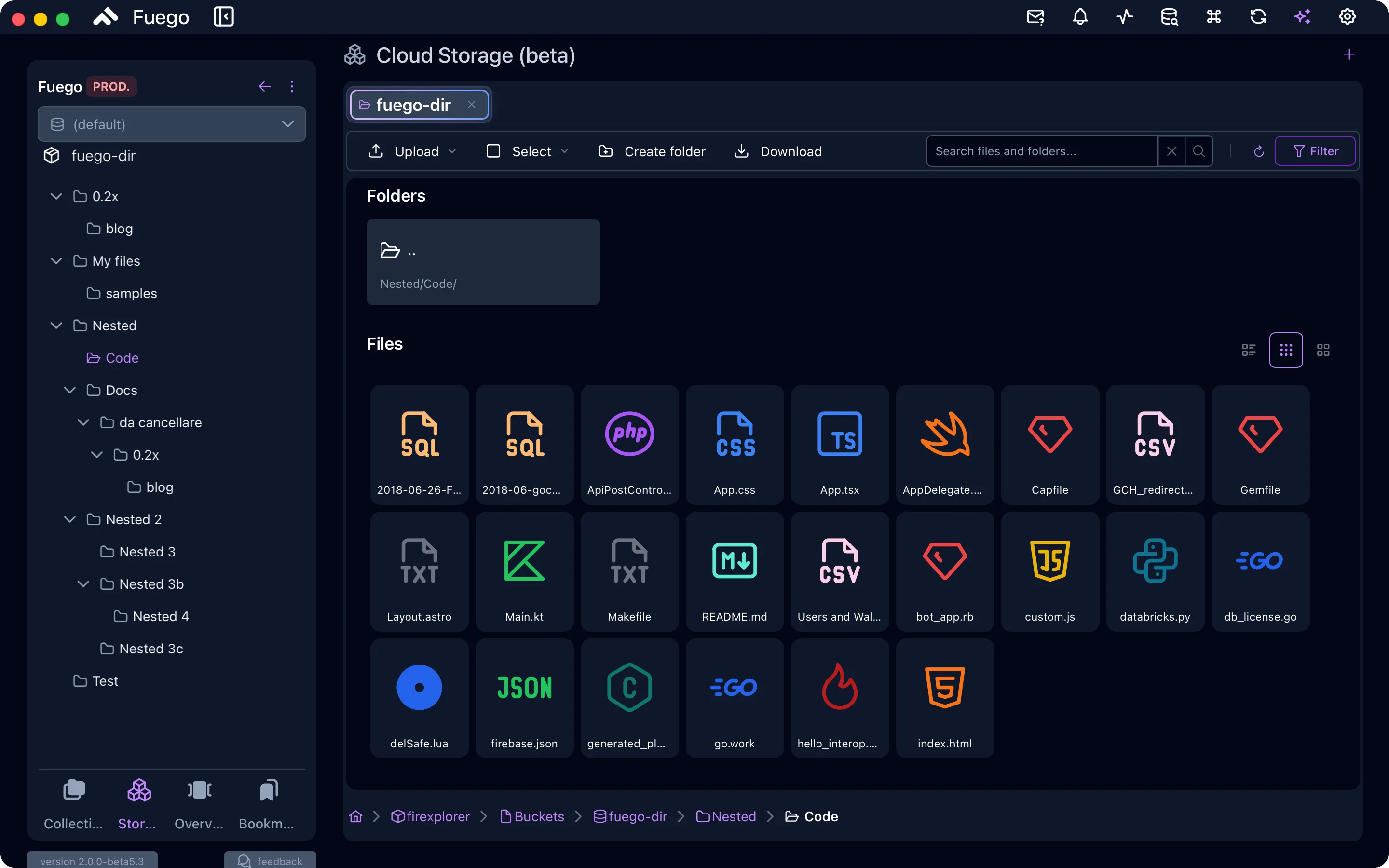
Fuego supports a wide range of file types, displaying clean and identifiable icons for each:
- Documents:
DOC,TXT,PDF,ODT - Code:
JS,TS,PHP,CSS,SQL,Swift,Ruby - Media:
GIF,PNG,JPG,MOV,MP4,AVI - Misc:
CSV,ICO,FAVICON
Moving and selecting files
File Management behaves like the file manager you already use:
- Drag & drop files and folders to move them between folders and buckets. Hold ⌥ Option (macOS) or Alt (Windows/Linux) while dropping to copy instead of moving.
- Drag selection — click on empty space and drag a rectangle to select several items at once.
- Compact icon view — a denser layout for buckets with many files, next to the existing list view.
Signed URLs
A signed URL lets anyone download a file for a limited time, without a Google account and without making the file public. Right-click a file and choose Create signed URL, or click Create signed URL in the file details. With several files selected, the same item (or Create signed URLs in the selection menu) creates one URL per file, with Copy all and Copy as JSON.
- Choose how long the URLs last: 15 minutes, 1 hour, 1 day, 7 days (the default and the longest Google Cloud Storage allows), or a custom duration.
- Projects connected with a service account key sign the URLs with that account.
- Projects connected with your Google account, or with Application Default
Credentials of a user, sign as a service account you choose (the Firebase
Admin SDK account is suggested). Your account needs the Service Account
Token Creator role on it (
roles/iam.serviceAccountTokenCreator). - Signed URLs are not available for emulator projects.
Key Features
- Multi-bucket support
- Signed URLs with a chosen duration, for one file or a whole selection
- Drag & drop move and copy, drag selection, compact icon view
- Advanced previews and metadata editing
- Fast navigation through folder structures
- Bulk upload/download
- Custom metadata support
- Point-in-time version history
Fuego simplifies your Firebase Storage workflows and gives you full control of your assets—right from your desktop.